Joint Forces
To counter the sharp rise in loneliness, the Flemish Government launched a plan to develop caring neighbourhoods. The way neighbourhoods are shaped, both physically and socially, has a major impact on our well-being. It creates the basic conditions for a society in which people feel connected.
Access to public parks and open spaces, the availability of public transport, the quality of housing: we realized that all of this was much less optional than we might have thought.
Many people, independently of the government, began to experiment spontaneously with all kinds of cooperation, sharing, and co-creation. Shared networks and pooled efforts proved to be a key ingredient for a warm and sustainable society. How strong are these networks today?
The schedule
7:30 pm | Welcome and introduction
by Erik De Bom, Acting Director of UCSIA
7:40 pm | Making space for loneliness
by Wouter Schepers (HIVA – KU Leuven)
Loneliness is often approached as an individual problem, yet the neighbourhoods we live in also play a crucial role. The COVID-19 crisis made it painfully clear how profound the impact of restrictions on contact and mobility can be, and it inspired ambitious plans to invest in proximity, caring neighbourhoods, and more attention to vulnerable groups. But what have we actually achieved since then?
In this lecture, Wouter Schepers shares insights from the four-year Strategic Basic Research project A Lonely Planet (2022–2026), which surveyed more than 3,700 Flemish residents and conducted in-depth neighbourhood case studies. Wouter explores how social and physical neighbourhood characteristics – such as contact with neighbours, local amenities, safety, and the design of public spaces – are related to feelings of loneliness. He also reflects on the lessons learned since COVID-19: which ambitions have been realized, which remained unfulfilled, and how can neighbourhoods continue to build warm, caring communities that help prevent, reduce, or address loneliness.
Wouter Schepers is a senior researcher at the HIVA Research Institute – KU Leuven, where he has worked since 2011 on topics such as poverty, housing, and social inclusion. He is currently conducting doctoral research on the relationship between neighbourhood characteristics and loneliness, with a particular focus on quantitative analyses.
8:20 pm | Citizens in action… on the power of civic initiatives in a vibrant democracy
by Nele Vanderhulst (Socius)
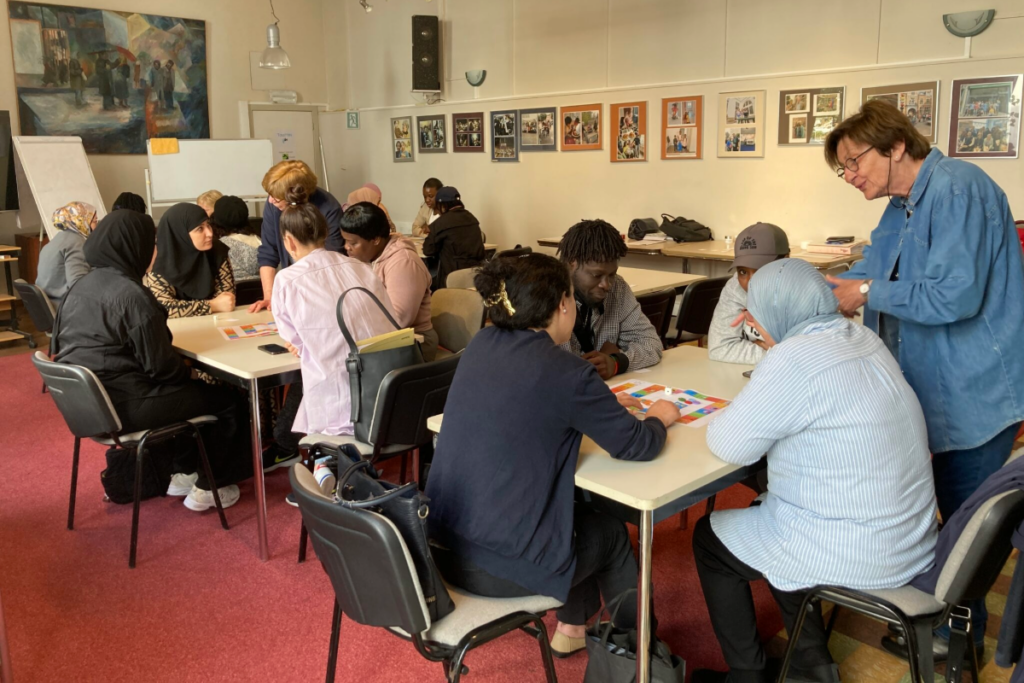
Many citizens pulled together during the pandemic. This ranged from small-scale, informal ways of sharing goods to well-organized and widely supported civic initiatives. Nele Vanderhulst illustrates how both the pandemic and other societal developments and movements (such as Black Lives Matter) made people more aware of their immediate surroundings and encouraged them to reflect on how to live, reside, work, and interact with one another.
This growing awareness contributed to an already emerging wave of civic initiatives. Citizens organize themselves independently and from the bottom up. They respond to pressing social issues that other actors fail to address, or they develop entirely new approaches to the same challenges. They focus on a wide range of topics, such as sustainable development, mobility, health and social care, democracy, equal opportunities… They organize themselves locally, regionally, across Flanders, and even internationally. In doing so, they act as a powerful engine for renewing civil society, showing governments and established organizations how things can – or should – be done differently.
Nele Vanderhulst has worked in youth work, as an organizational consultant, and in the socio-cultural sector. She is a staff member at Socius, the support centre for socio-cultural work. Her work focuses on politicizing practices and civic initiatives.
9:00 pm | Q & A
9:30 pm | End

U-turn: 5 years later
This is the third lecture in the series U-turn: 5 years later, in which we explore the lasting impact of the COVID period.
When COVID-19 broke out in 2020, our society came to a standstill. Suddenly, there was space to imagine a new way of living together, with greater attention to humanity, solidarity and social justice.
Five years have passed. What is left of those noble intentions?
Discover the other lectures in the series:
- Keep Your Distance! on 29 January 2026 with Erika Vlieghe (UZA) and Lindsy Desmet (KU Leuven)
- The Numbed Society on 24 February 2026 with Lies Gremeaux (Sciensano) and Anthony Longo (Tilburg University)
- Reference Points for a World in Flux on 28 April 2026 with Koert Debeuf (Brussels School of Governance) and Maarten Rabaey (De Morgen)
Listen to the podcast Solidariteit Spreekt!
In the first season of our podcast Solidariteit Spreekt, we build up towards the lecture series U‑turn: 5 years later.
Journalist Linda De Win, together with experts, examined developments in solidarity, sustainability, and future thinking through the lens of the COVID period.
Discover the podcast series Solidariteit Spreekt!
- Urban sociologist Stijn Oosterlynck (University of Antwerp) and Naima Charkaoui (11.11.11) on solidarity and international cooperation
- Cathy Macharis (House of Sustainable Transitions – VUB) and Eva Smets (Oxfam Belgium) on sustainability and social justice
- Bert De Munck (University of Antwerp) and Jorgen Stassijns (Sciensano) on thinking about the future