Listen now!
Don’t want to miss a single episode of Solidariteit Spreekt?
From hopeful U-turn to harsh reality?
In 2020 and 2021, UCSIA published two books in which Flemish experts viewed the pandemic as an opportunity for a societal U-turn. Five years later, we ask ourselves: has that turnaround actually happened?
The reality is harsh. Geopolitical conflicts, the climate crisis and the rise of populism have overshadowed the hope for structural change.
Warm versus cold solidarity
During the pandemic, we witnessed spontaneous forms of solidarity: people applauded healthcare workers, helped neighbours in need, and followed strict measures out of concern for the vulnerable. This is often referred to as warm solidarity.
But structural cold solidarity, such as social protection provided by the welfare state, also played a crucial role. According to Oosterlynck, the distinction between warm and cold is not always meaningful: indirect support is often highly effective and can also be experienced as warm and meaningful.
International solidarity under pressure
Charkaoui highlights the global dimension of solidarity. Although there was initially a shared sense of common fate, the discourse quickly shifted. Rich countries began hoarding vaccines, multilateral cooperation deteriorated, and international institutions received fewer resources and less support.
The pandemic showed how connected we are, but also how fragile international solidarity is.
It is highly contradictory that many political leaders today choose to turn inward, while the looming crises, such as climate change, can only be addressed globally.
More or less solidarity?
According to Stijn Oosterlynck, there is neither more nor less solidarity at the local level. However, the groups with whom we want to show solidarity are defined differently.
A striking trend is welfare chauvinism: an increasing number of citizens feel solidarity only with people of the same nationality and ethnic group.
Naima Charkaoui points out that, internationally, there has certainly been a decline in solidarity. With Trump at the forefront, many governments are cutting back on budgets for international cooperation and development aid.
Inequality
The COVID crisis also exposed existing inequalities, such as in housing and working conditions. Although there was temporarily more social protection, structural improvements have not materialized.
The gap between rich and poor has even widened, both nationally and internationally. Many investments in private sectors such as the pharmaceutical industry and IT were made with public money. However, the profits were privatized.
Hopeful signs
Nevertheless, there is also hope, according to Professor Oosterlynck. Solidarity is an ingrained reflex in Belgium when dealing with any crisis, and that is not questioned. In the US, for example, such a reflex is unthinkable.
He observes that proximity and social infrastructure in cities have gained momentum: local health centres, community centres, and associations strengthen local resilience.
Naima Charkaoui points to the strong foundation of engaged citizens and NGOs actively promoting solidarity, both locally and internationally. She believes that social engagement can serve as an antidote to the uncertainty and fear instilled by the current world view.
She also noted that there is a great deal of expertise and know-how in the Global South. During COVID, some countries even sent aid to Europe. So there is a global commitment to move toward greater justice and a more global approach.
“I believe it is a fact that you cannot put Belgium, or the European Union, under a bell jar. We are, after all, globally connected through migration, the economy, pandemics, and so on. Policies must reflect this reality, because denying it will never lead to a better world for everyone. And I truly believe that. By addressing global challenges worldwide, we will also see improvements here in Europe.”
Naima Charkaoui, directeur beleid 11.11.11
“Solidarity always requires effort; it does not happen automatically. These are things that need to be cultivated and developed, that require institutions to support them, that require groups to safeguard them.”
Stijn Oosterlynck, professor stadssociologie Universiteit Antwerpen
Policy recommendations
Stijn and Naima also have some recommendations for policymakers: invest in local networks and neighbourhood facilities that foster solidarity, strengthen multilateral cooperation and international solidarity, and learn from past crises to better address future challenges.
Both believe that solidarity cannot be taken for granted, but is something that must be actively cultivated with a long-term vision.
Conclusion
This episode of ‘Solidariteit Spreekt’ shows that solidarity cannot be taken for granted, but requires active effort. However, the discussion also offers hope: despite political and economic pressures, there is still broad public support for solidarity, justice, and cooperation.
Listen and discover how COVID-19 has changed our view of solidarity, what lessons we can take for the future, and what role you can play in a more just and connected society.
Want to stay up to date on new episodes and events?
What does the future hold?
In the spring of 2026, UCSIA will organize the lecture series U-Turn: 5 years later, in which we take stock: has the pandemic truly changed us?
Topics such as loneliness, addiction, citizens’ initiatives, and authoritarian leaders are addressed. We continue to search for hopeful perspectives in a world full of challenges.
Want to know more about U-turn: 5 years later?
Contributors to this episode
Colophon
Host: Linda De Win
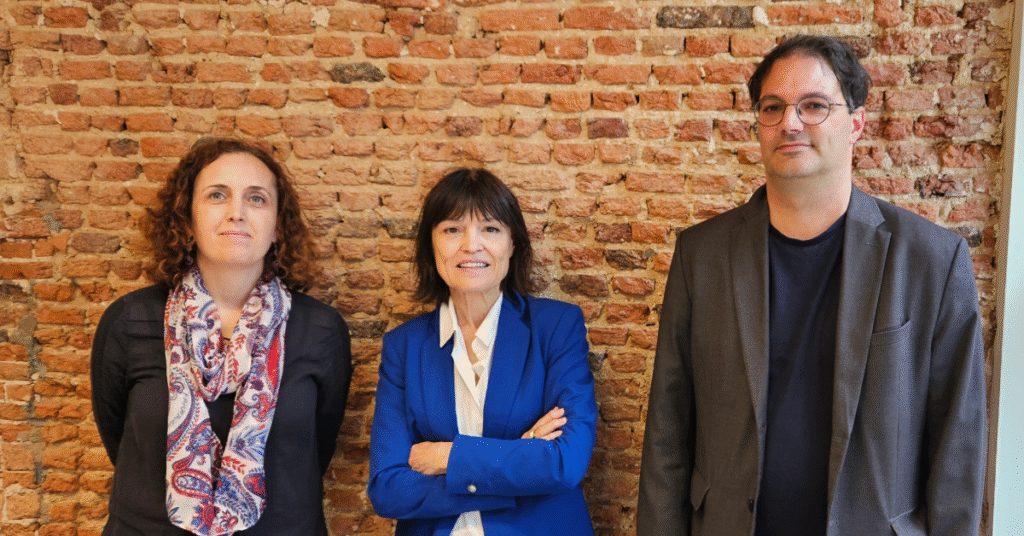
Guests: Naima Charkaoui (11.11.11) and Stijn Oosterlynck (University of Antwerp)
Editors: Kaat Somers and Erik De Bom
Production: Kaat Somers and Marijke Celis
Communication: Marijke Celis
Editing and mixing: AV Inspire
Music: Giuseppe Minervini
Voice intro & outro: Gilke Gunst

Linda De Win
Linda De Win is a journalist. She worked for over 30 years at the VRT news service, where she specialized in reporting on domestic politics. She worked for Het journaal, Terzake, and De zevende dag. From 2006 to 2021, she hosted the parliamentary programme Villa Politica.
By training, she is historian. She completed her bachelor’s degree at UFSIA and her master’s degree (specializing in contemporary history) at Ghent University. She is passionate not only about her field of study, but also about everything happening in society. She currently works as a journalist, podcast host, and moderator.

Naima Charkaoui
Naima Charkaoui studied political science at Ghent University. Since 2001, she has been engaged in human rights, inequality, and racism: first for over ten years as head of the Minorities Forum (a coalition of grassroots migrant organizations), later at children’s rights organizations, and currently at 11.11.11 as policy director. She has also written several books, mainly on racism.

Stijn Oosterlynck
Stijn Oosterlynck is professor of urban sociology at the University of Antwerp. He is a member of the executive board of the Hannah Arendt Institute for Diversity, Urbanity and Citizenship. His research focuses on poverty and diversity in cities, urban civil society, urban social innovation, and social urban renewal.