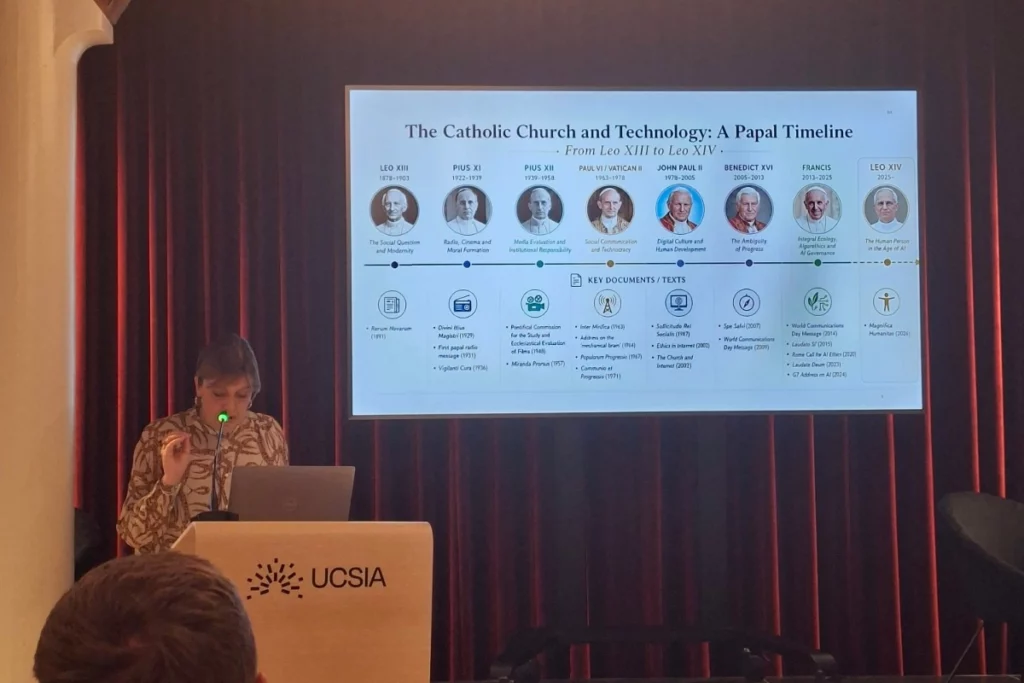
Historical Trajectories and Contemporary Challenges in the Catholic Church's Approach to Technological Innovation
How can we interpret the encyclical Magnifica Humanitas today, in light of more than a century of evolving relations between the Catholic Church and technological innovation?
Balance between openness and rejection
This lecture traces the long and nuanced engagement between the Catholic Church and communication technologies — from the arrival of radio and mass media to today’s digital platforms and artificial intelligence systems.
Rather than swinging between uncritical enthusiasm and outright rejection, the Church has historically sought to balance openness to innovation with attention to its ethical, social, and spiritual implications.
Across the twentieth and twenty-first centuries, Catholic reflection on technology has consistently returned to the centrality of human dignity, responsibility, and the common good.
Franciscus, Leo XIV and the Magnifica Humanitas
Professor Vitullo will give particular attention to the pontificate of Pope Francis, whose leadership fostered a more pragmatic and dialogical approach to digital culture, and to the ways in which this approach has shaped the emerging vision of Pope Leo XIV as articulated in Magnifica Humanitas.
This document places artificial intelligence at the centre of contemporary ethical reflection, raising pressing questions about human agency, creativity, freedom, and flourishing in an increasingly automated world.
Tradition as a compass
By tracing both continuity and change in Catholic approaches to technological innovation, the lecture shows how current debates on AI form part of a much longer tradition of theological and ethical engagement with media technologies.
Furthermore, the lecture will explore what intellectual and moral resources that tradition might offer for addressing the challenges posed by emerging forms of artificial intelligence.
Practical information
The programme will be in English.
Registration is free and open to all. You can either join us in Antwerp or online via livestream.
Schedule
- 19:00 | Doors
- 19:30 | Welcome & introduction
- 19:35 | Lecture by Alessandra Vitullo
- 20:15 | Q&A
- 20:30 | End of the programme

About Alessandra Vitullo
Alessandra Vitullo is a researcher and lecturer at Sapienza University of Rome, where she teaches sociology of communication and migration.
She is the scientific coordinator of the Laboratory on Religions and Social Change at the SARAS Department, and co-director of the Network for New Media, Religion and Digital Cultures at Texas A&M University.
She is also a visiting scholar at the Universidade do Rio Grande do Sul (Brazil) and has previously held research and teaching positions at the University of Milan Bicocca, Fondazione Bruno Kessler (Trento), Uppsala University, and KU Leuven.
This year, Professor Vitullo is joining the UCSIA Summer School faculty for the first time.

About the UCSIA Summer School
This lecture is the public event of the UCSIA Summer School.
For over 20 years, the UCSIA Summer School has explored the complex intertwining of religion, culture, and society.
This edition focuses on the ways in which religious publics and forms of religious publicity are being reshaped by digital technologies, platforms, and political economies.
The summer school offers an interdisciplinary forum for doctoral and postdoctoral researchers working on religion, and encourages reflection on how religion is experienced through digital media and the online sphere.