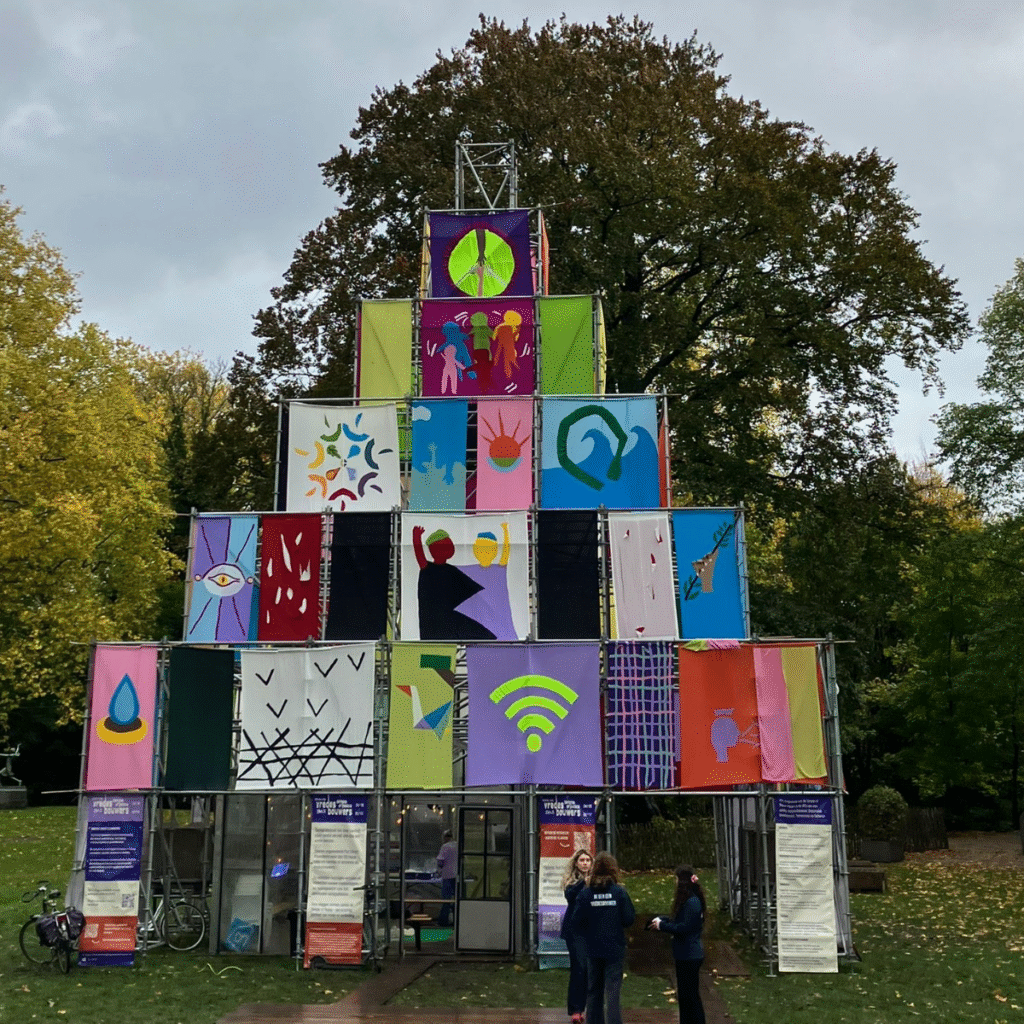
The summer school is a closed programme for selected bachelor’s students. However, there are also two public sessions, which you can attend either live in Lille or online.
From crisis to construction
Last year’s Summer School, European Humanism and Populism, examined how populist movements challenge Europe’s moral and democratic foundations. It revealed how fear, division, and identity politics corrode the shared values at the heart of the European humanist tradition.
This year continues that conversation, shifting from crisis to construction: from understanding the forces that divide to exploring the practices that reconcile.
The 2026 theme asks what kind of humanism is required not merely to preserve peace, but to make it. Peace is a continual act of imagination, solidarity, and hope.
A humanism tested and transformed
Creative efforts for peace
Peace is not merely the absence of war. As the Schuman Declaration reminded Europe, “World peace cannot be safeguarded without the making of creative efforts proportionate to the dangers which threaten it.”
European humanism has always sought such creativity. From Medieval Just War Theory to Kant’s Perpetual Peace, from post-war reconciliation to the European Union’s founding vision, peace has been understood as a work of culture and conscience.
Moral architecture of peace
But the moral architecture of peace is again under strain. The war in Ukraine, the resurgence of nationalism, and the persistence of inequality have exposed Europe’s vulnerability.
The “culture of peace” born after 1945 – rooted in human rights, cooperation, and shared prosperity – can no longer be taken for granted.
The task now is not only to defend that culture but to remake it, integrating new perspectives from history, faith, art, and civil society.
Dignity and dialogue
In Pacem in Terris (1963), Pope John XXIII wrote that true peace “is founded on truth, built up on justice, nurtured and animated by charity, and brought into effect under the auspices of freedom” (§167).
Yet this insight harmonizes with a broader interreligious vision. Many traditions align and inform the European humanist conviction that dignity and dialogue must prevail over domination. All converge in recognizing that peace is not a condition to be maintained, but an endeavour to be commonly pursued.
Structure of the week
The week follows five interlinked academic courses, each addressing a key dimension of European humanism’s relationship with peace. Together they trace a journey from the roots of European consciousness to its civic expression in action.
The programme combines lectures, workshops, cultural visits, and simulation exercises, culminating in collaborative creative work and public reflection.
Course I – The Contribution of History to European Consciousness
The opening course establishes the historical foundations of Europe’s legal, moral, and political identity.
It considers how memory of conflict has shaped the continent’s understanding of itself, from the devastation of the world wars to the emergence of the post-war peace project.
The participants will explore the double legacy of European history: its capacity for both destruction and reconciliation. Special regard will be given to the Schuman Declaration which celebrates its 75th anniversary.
The day concludes with a city walk, situating these questions within the physical and memorial landscape of the host city.
Course II – Literature, the Arts, Translation and European Identity
Art and literature have long served as Europe’s conscience, bearing witness to both suffering and renewal. This course examines how poetry, fiction, and the arts express the longing for peace and the pain of loss. Translation, both linguistic and cultural, becomes a metaphor for peace itself: the movement towards understanding the other.
The students will analyse how the arts cultivate empathy and how cultural memory can be reimagined as a resource for reconciliation rather than resentment. They will be asked to reflect and engage with their own narrative construction through creative writing on the theme of the week.
Course III – The European Enlightenment and the Islamic Heritage
This course explores the intellectual and interreligious roots of European thought. The Enlightenment’s faith in reason, dialogue, and universal dignity emerged not in isolation but in conversation with Islamic philosophy and science.
By revisiting this shared heritage, participants will consider how intercultural exchange shaped the modern idea of peace.
The discussion will also address how contemporary Europe might recover this openness in dialogue with its Muslim citizens and neighbours, recognizing peace as both an internal and external relationship.
Course IV – European Social Humanism
This course examines the political and social expressions of peace within the European tradition. It traces how liberal and republican ideas — of individual freedom, civic virtue, and the common good—have shaped Europe’s search for a just social order.
From post-war reconstruction to the development of the welfare state and the European Union, these traditions reveal peace as a political as well as a moral achievement.
Drawing also on Fratelli Tutti and contemporary debates on solidarity, the course asks how social humanism can be renewed amid current divisions.
The visit to Flanders Fields, Ypres, offers a moment of reflection on the cost of war and the vocation of peace in public life.
Course V – Civic Engagement in Action
The final course focuses on practice. Through workshops and simulation games, participants will apply the insights of the week to real-world contexts — local, European, and global. The emphasis is on agency: how students, as future leaders and citizens, can act as artisans of peace.
The Summer School concludes with the Performing Europe session, where participants present stories and collaborative projects that translate their learning into creative public expression.
They will also engage in an exercise to reflect upon the dynamics of political interaction at a European level.
Public lectures
The FUCE Summer School offers two open lectures to the wider audience (with possibility to attend online):
- an opening lecture on Tuesday evening with an expert who will introduce the topic of this year’s edition and
- the panel debate MyEurope on Wednesday evening, with some of the participants sharing their visions of and for Europe.
Conclusion
The making of peace is neither automatic nor assured. It is a moral and cultural task that demands imagination, humility, and cooperation.
European humanism – shaped by faith and reason, by dialogue and diversity – teaches that peace arises where truth and justice meet, where mercy tempers power, and where the dignity of every person is upheld.
The 2026 FUCE Summer School will therefore not only study peace but practise it: through encounter, artistic creation, dialogue, and shared hope.
To return to Pacem in Terris, peace “is the fruit of ordered relationships” (§167)—and those relationships, across disciplines and cultures, are precisely what this Summer School seeks to form.
In bringing together students from the Federation’s universities, FUCE affirms once more the mission at the heart of European higher education: to form communities of learning that become, in their very diversity, humanism in the making of peace.
Organizers
UCSIA is organizing this summer school in collaboration with the European Federation of Catholic Universities (FUCE), Université Catholique de Lille, and with the support of Erasmus+.