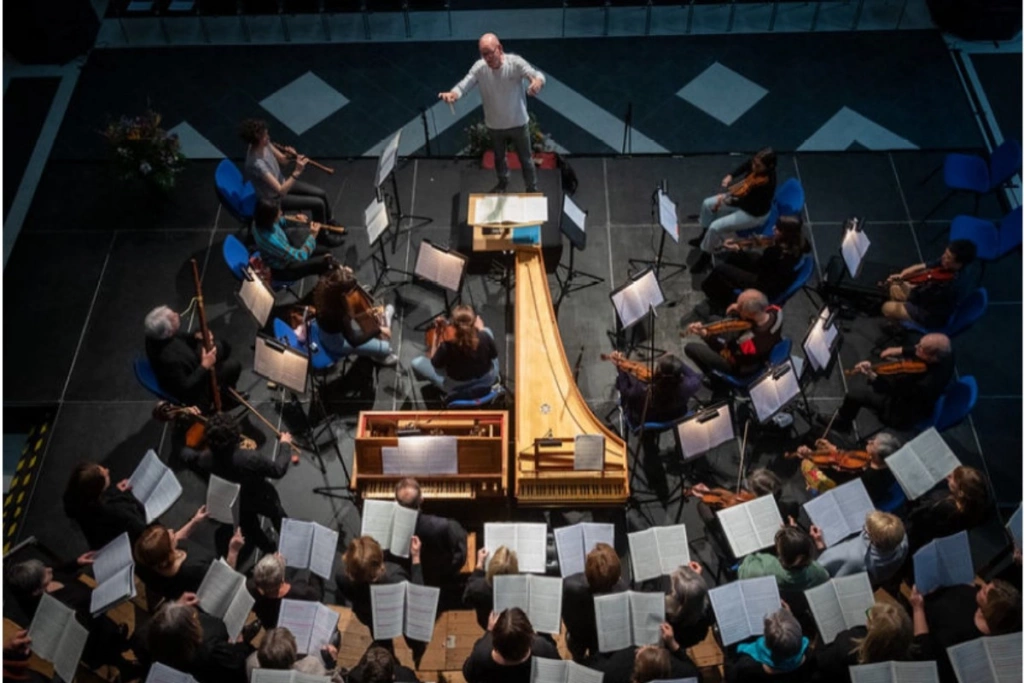
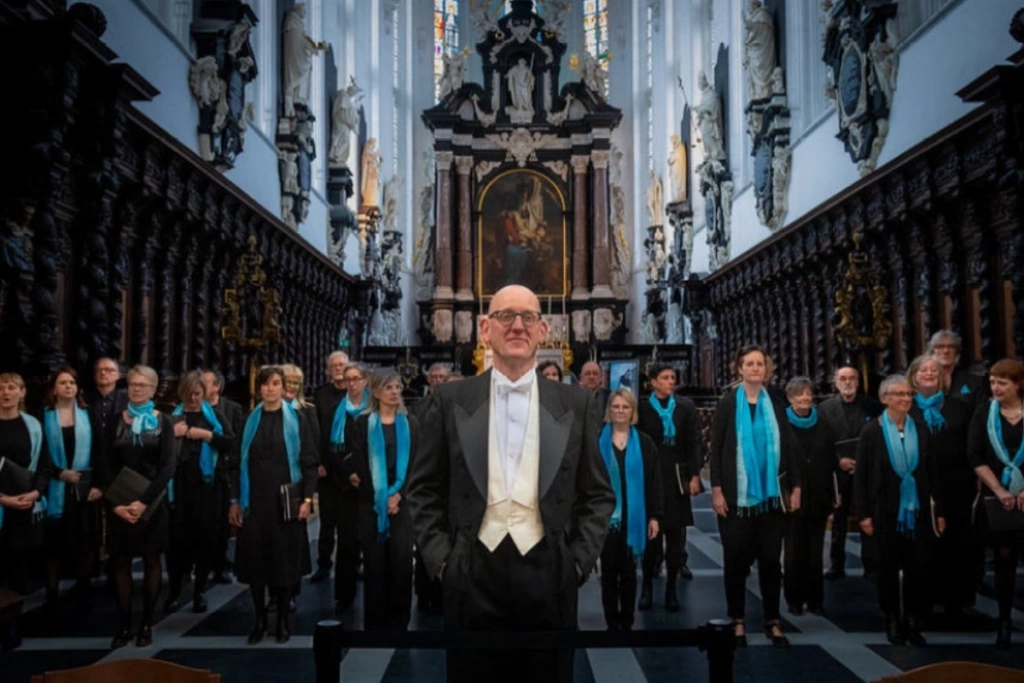
From piano lessons to his own ensemble
Mannu’s journey into the Baroque began by chance. He was six when he learnt to play the piano, and nine when his piano teacher – who had founded a Baroque ensemble himself – asked him to sing as a boy soloist in the St Matthew Passion. “I agreed, and somehow it really got to me, even though I was only nine. It was captivating and complex too. I couldn’t quite put my finger on why at the time, but it struck a chord. Since then, Bach has never really left me.”
During the concerts, he also became fascinated by the instruments in the orchestra, particularly the keyboard instruments such as the organ and the harpsichord. “I would always try them out carefully, as I’d already learnt a little piano by then. That’s where the seed was sown for me to go on to build instruments myself. For me, building and performing are two sides of the same interest: understanding how music is made – on the one hand, the analysis, but also the emotion and its expression.”
Almost fifty years ago, as a young lad of seventeen, he took his place in front of an ensemble as a conductor for the first time. At first, he was hesitant and cautious. Twenty years later, in 1997, he founded his own company: Alegría Musical Ensemble.
What makes Baroque music so special to him? “For me, there’s something very direct about Baroque music. It’s both highly structured and mathematically organized, but also very expressive.” He freely calls it “the pop music of the eighteenth century”: rhythmic, emotional, captivating.
“As a performer, I feel as though I am in dialogue with the composer. I feel as though I am close to him. I can then ask myself: Why is there an accent here? Why is there dissonance here? Why does that line go up or down? And, after unravelling all that, to arrive at a feeling, an expression.”
Professional music enthusiasts
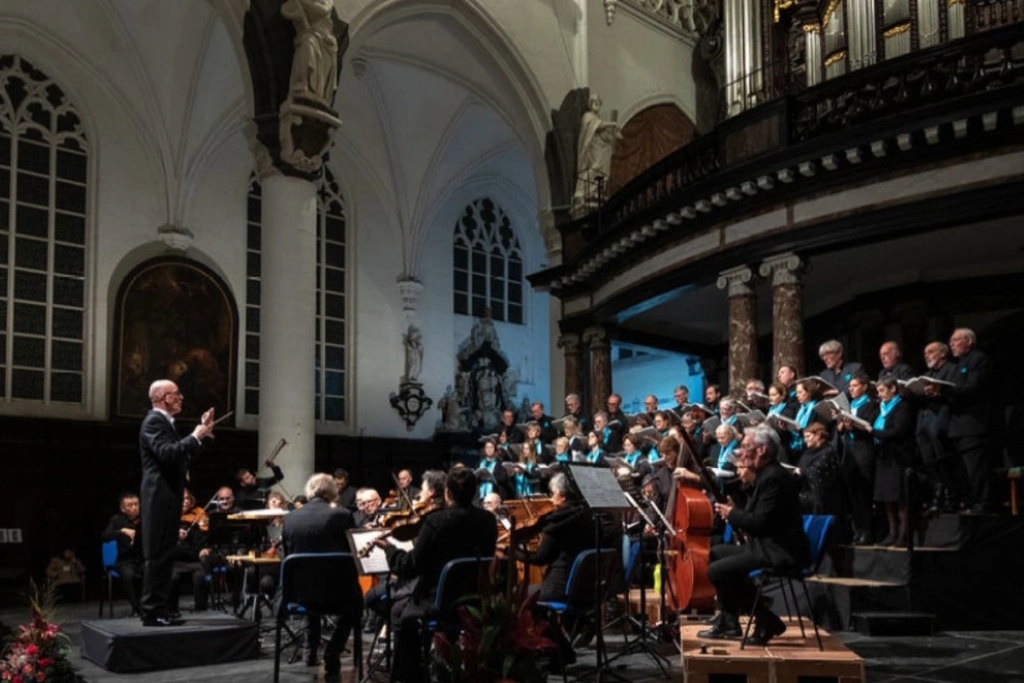
Alegría consists of a choir of passionate music lovers and a professional Baroque orchestra. “I draw a distinction between professionals and professionalism,” says Mannu. “Professionalism is an attitude I expect from everyone. The professional musicians bring their technical skill and expertise to the table, and naturally I can work more quickly with them. But it is not a mark of quality. It is not a case of merely amateurs versus professionals. We create the productions together, and everyone has a responsibility in that. That is a unique balance and a formula that is not all that common in the choral landscape in Flanders.”
Mannu loves being a conductor. He sums up the reason for this briefly: people’s enthusiasm. “I see people who devote their free time to our project, who learn their parts and keep working with me to find ways to improve.”
The same goes for working with the orchestra, of course.
“It’s about bringing together the energy of all those people – both professionally and from the heart – and using that to create a professional product together.”
“At a certain point, everything comes together and exceeds the sum of the individual voices. I consider it an enormous privilege to be able to guide that process.” That is the moment that gives him the greatest sense of fulfilment.
“Being able to do what I love, knowing that it inspires people and that they’re happy with the result. That’s brilliant. And actually, it’s an ongoing process. Long before the concert itself, preparations are already in full swing: not just musically, but also in terms of logistics and organisation.”
Warm, bright and lively
Mannu describes the sound and atmosphere of Alegría as “warm”. “Both in our interaction with people and in the sound itself. But it’s also clear, and certainly full of energy. I think we excel at energetic music. It suits us well.”
What happens between the musicians is at least as important. “The most important thing about an ensemble is the chemistry that comes from listening to one another,” says Mannu. “That creates a kind of homogeneity, without it becoming anonymous: a single sound, in all its diversity.”
In addition, the orchestra plays on period instruments. “These produce a warmer, more intimate and more transparent sound than modern instruments,” he explains. “From a physics perspective, everything sounds just a little bit softer: a Baroque trumpet without valves, a wooden traverso instead of a modern cross flute, violins with gut strings instead of metal strings. That makes the sound more intimate.”
“The most important thing about an ensemble is the chemistry that comes from listening to one another. This creates a kind of homogeneity, without it becoming anonymous: a single sound, in all its diversity.”
Before the doors open
According to Mannu, there is no secret formula that guarantees a concert will go well. “No, I don’t always wear the same socks,” he laughs, “but there is a specific atmosphere before every concert. It’s a mix of concentration and practical hustle and bustle: making sure we’ve got everything ready on time, that the audience can get in on time, going over a few passages one last time…”
“We do have a practical routine. There’s always a ‘raccord’, as musicians call it: we meet well in advance, sing and play a bit to warm up, and have a sandwich together. That creates a sense of connection, and the excitement and energy build naturally as we approach the moment the doors open.”
An evening filled with Bach
The programme brings together Bach’s Magnificat and two Christmas cantatas: exuberant at times, with timpani and trumpets, yet also very delicate and intimate.
The Magnificat performed by Alegría is actually Bach’s second version of the work. He originally wrote it for the Christmas liturgy, with four additional ‘Christmas interpolations’ inserted throughout. These are short passages – two in German and two in Latin – which were inserted only at Christmas. When Bach later revised it, he omitted them. For this concert, Alegría has deliberately reinserted them to bring the work’s Christmas context back to life.
They will also perform two Christmas cantatas written for this period: Gloria in Excelsis Deo (BWV 191) for Christmas Day, and Ich freue mich in dir (BWV 133) for the third day of Christmas.
“It is very much a Christmas story,” says Mannu, “even though we’re not performing the Christmas Oratorio.” The story begins small, and then takes on a meaning that grows: joy, hope and wonder – themes that often recur in Bach’s work.
For him, the Magnificat also contains a message: the idea that the world could be different, and that we ourselves can play a part in that, that we have an impact on the direction the world is taking. “So it’s not just a historic or museum piece, not just something from 1723. It’s relevant today, too. That’s what Christmas is all about.”
Wings and goosebumps
Mannu himself is particularly looking forward to the opening bars of the Magnificat: “The orchestra launches straight into it, then the choir joins in. It really gives us wings.”
Further on in the piece, there is a moment that he already knows will move him: “In the Suscepit Israël, the women’s voices blend so simply and tenderly, accompanied by an almost weightless melody. At the words ‘recordatus misericordiae suae’ – mindful of his mercy – I already know I’ll get goosebumps.”
Not sure whether Baroque music is your thing? Mannu has a simple piece of advice: “Don’t decide in advance whether you’ll like it. Just come along and let yourself be carried away by the sound and energy – Bach will do the rest.”
Music and purpose as bridges
It was no coincidence that UCSIA found common ground with this concert. “We’re both building bridges,” says Mannu, “UCSIA through knowledge and spirituality, and we through music. In both cases, it’s about coming together: you step out of your own world and make room for something else.”
The musicians are playing music from the past today. The audience comes from different backgrounds and holds a variety of beliefs. But we connect. We come together. We make room for something different.”
Bach wrote these works from a particular spiritual perspective, a conviction. “But you certainly don’t have to think or believe the same way to listen to or perform his music. You can do so from a completely different perspective.”
“I don’t mean to downplay Bach’s spirituality. It is important. And for me, it helps me to get closer to it. But I don’t think it’s at all a necessity to be moved by his music.”
The repertoire is about joy, hope and anticipation. “That’s 18th-century, but just as much 21st-century, of course.” These are feelings we’re all familiar with. They build a bridge between people from different worlds and eras, each of whom is moved in their own way by the same music. “You can’t force that. There’s no guarantee it will work, but it’s an opportunity to open yourself up to it and experience it. I believe it can make quite a difference.”
This concert is, without question, a must for anyone who loves Bach, but equally so for those who know Bach only by name. Mannu is thinking in particular of people who, during the busy month of December, want to slow down a little and share something with others: “Hearing Bach live, with a choir and orchestra, is very different from listening to a CD at home. I hope that afterwards, people will not just feel that they have heard some music, but that they have experienced something.”
Will you be there?
Would you like to enjoy this concert? Subscribers to our newsletter get a 10% discount on their tickets (€26 instead of €29). The discount link will appear in the November newsletter.
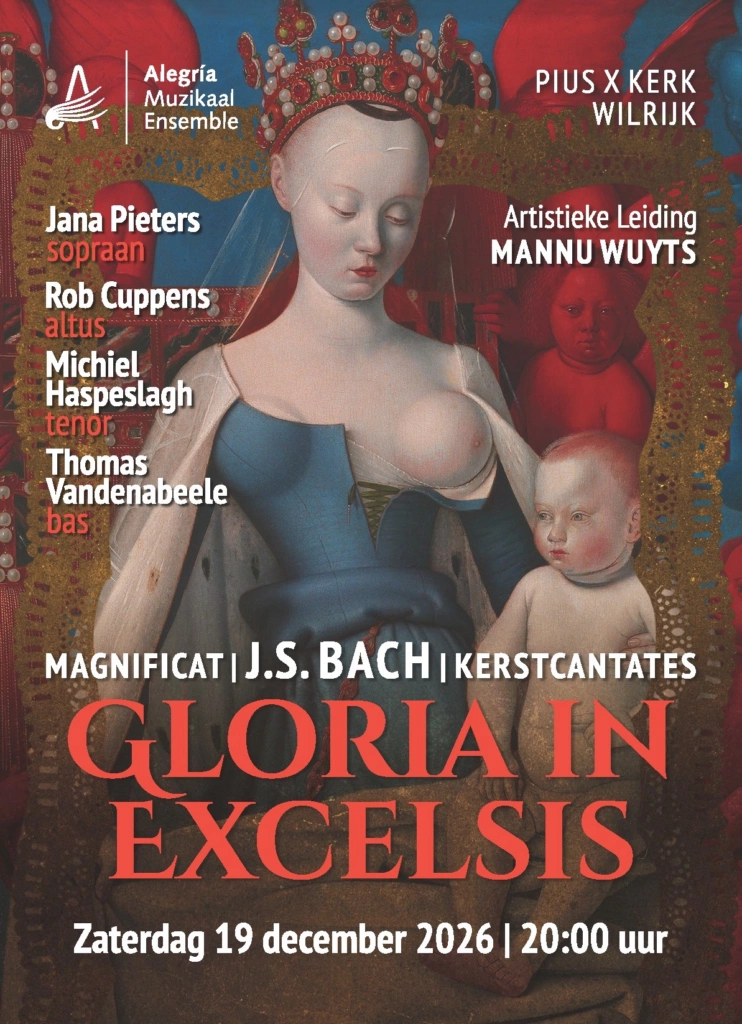
Concert "Gloria in Excelsis"
J.S. Bach: Magnificat & kerstcantates
by Alegría Musical Ensemble conducted by Mannu Wuyts, with soloists Jana Pieters (soprano), Rob Cuppens (altus), Michiel Haspeslagh (tenor), and Thomas Vandenabeele (bas)
Time and location
Saturday 19 December 2026, 20.00 CET
Pius X Church, Groenenborgerlaan 214, Wilrijk-Antwerp
Tickets
€ 29, presale until December via www.alegria-online.be, via email to kaarten@alegria-online.be, or by telephone: 0486 27 91 95.
Discount for UCSIA subscribers
Subscribers to our newsletter receive a 10% discount (€26 instead of €29). You’ll find the discount link in the November newsletter.