The Numbed Society
Five years after the COVID‑19 crisis, its traces remain visible — even in places where we might not immediately expect them. During the second evening of the lecture series U‑turn: 5 years later, UCSIA invited two experts to explore a theme that everyone experienced first-hand during the pandemic, yet one that is rarely examined systematically: the numbed society.
Drugs: a slight increase, but the real concern lies elsewhere
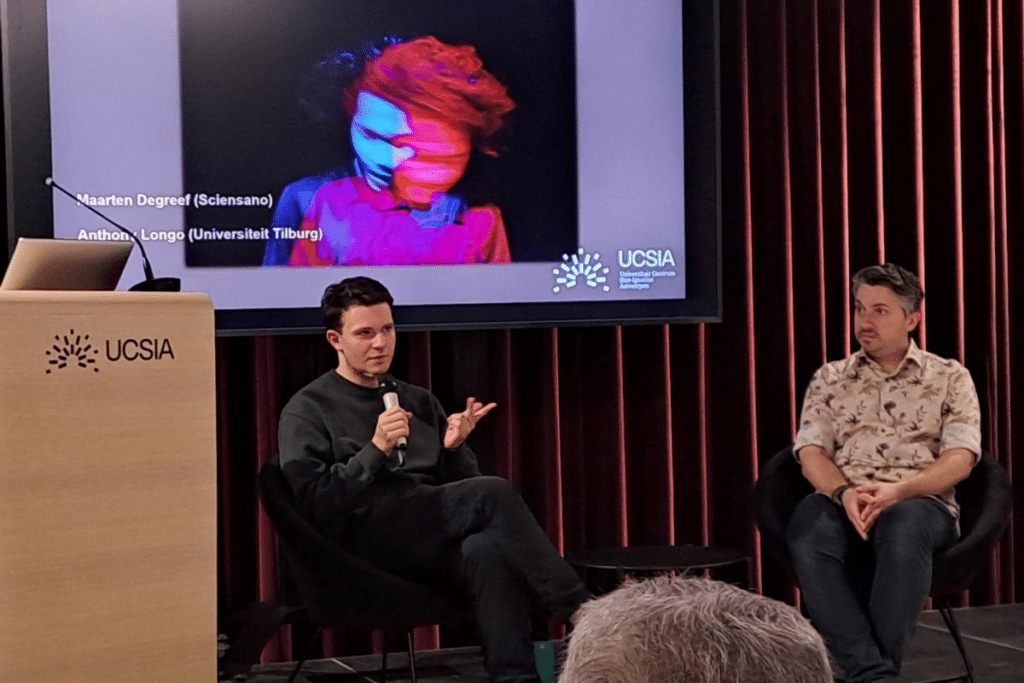
Maarten Degreef, forensic toxicologist at Sciensano and affiliated with the Belgian Early Warning System on Drugs, presented a nuanced picture of the use of cannabis, cocaine, ecstasy, and amphetamines. For all of these substances, a slight increase can be observed, but this trend was already underway before the pandemic and is probably not related to it.
The real concern lies elsewhere. Year after year, new psychoactive substances are appearing on the Belgian market. In 2020 there were 14; a year later, that number had already doubled. Users are often unaware that they are consuming these substances, let alone what effects they might expect. At the same time, polydrug use is on the rise: more and more people are combining different substances, either simultaneously or on the same evening. This makes the risks far more difficult to assess – both for users themselves and for those providing support and care.
Social media: the public space has moved into the living room.
Anthony Longo, a postdoctoral researcher in ethics and philosophy of technology at Tilburg University, approached the issue from a different angle. For many people, social media became a personal lifeline during the lockdowns, but they grew into much more than that.
When the physical public space largely disappeared, public debate shifted to social media, and that shift has not been reversed since. The public sphere is now also located in the living room: it is there that opinions are formed, protests emerge, and political debates take place.
Longo, however, warns against an overly one-sided view of this development. Those who frame social media purely as a psychological threat – toxic, addictive, an epidemic – risk overlooking the fact that, for many young people, these very platforms are the only safe haven they know. Policies based solely on that narrative miss an essential part of reality.
Don’t miss the next lecture!
The U-turn: 5 years later series continues. We still have one more lecture scheduled. On 28 April 2026, we welcome Koert Debeuf (VUB) and Maarten Rabaey (De Morgen) for an analysis of geopolitical shifts and the role of the media in times of disinformation and increasing pressure on press freedom.

U-turn: 5 years later
This is the second lecture in the series U-turn: 5 years later, in which we explore the lasting impact of the COVID period.
When COVID-19 broke out in 2020, our society came to a standstill. Suddenly, there was space to imagine a new way of living together, with greater attention to humanity, solidarity and social justice.
Five years have passed. What is left of those noble intentions?
Discover the other lectures in the series:
Listen to the podcast Solidariteit Spreekt!
In the first season of our podcast Solidariteit Spreekt, we build up towards the lecture series U‑turn: 5 years later.
Journalist Linda De Win, together with experts, examined developments in solidarity, sustainability, and future thinking through the lens of the COVID period.
Discover the podcast series Solidariteit Spreekt!
- Urban sociologist Stijn Oosterlynck (University of Antwerp) and Naima Charkaoui (11.11.11) on solidarity and international cooperation
- Cathy Macharis (House of Sustainable Transitions – VUB) and Eva Smets (Oxfam Belgium) on sustainability and social justice
- Bert De Munck (University of Antwerp) and Jorgen Stassijns (Sciensano) on thinking about the future