Enchantment and disenchantment
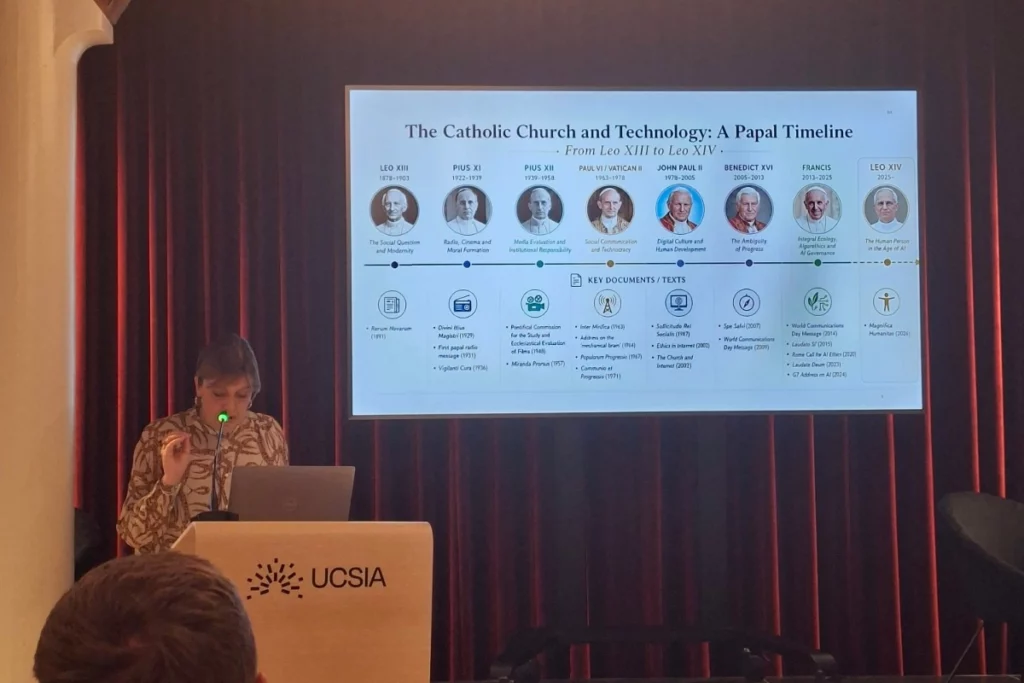
Vitullo argues that the Church’s language about technology moves in cycles of enchantment and disenchantment: technology is celebrated as a gift of God when it serves ethics and community, and challenged once it exceeds moral limits.
That tension runs from Rerum Novarum (1891), through Laudato Si’ (2015), to Leo XIV’s brand-new encyclical, which explicitly echoes his namesake, Leo XIII.
After the lecture, the audience discussed digital literacy, intellectual property in the age of AI, and whether and how we can ever really disconnect from our screens.
About Alessandra Vitullo
Alessandra Vitullo is a researcher and lecturer in sociology of communication and migration at Sapienza University of Rome. She directs the Laboratory on Religions and Social Change at the SARAS Department and co-directs the Network for New Media, Religion and Digital Cultures at Texas A&M University.
About UCSIA Summer School
This lecture is the public event of the UCSIA Summer School.
For over 20 years, the UCSIA Summer School has explored the complex intertwining of religion, culture, and society.
This edition focuses on the ways in which religious publics and forms of religious publicity are being reshaped by digital technologies, platforms, and political economies.
The summer school offers an interdisciplinary forum for doctoral and postdoctoral researchers working on religion, and encourages reflection on how religion is experienced through digital media and the online sphere.