The lecture will be in English.
AI and our collective memory
Can an algorithm determine how we remember our history?
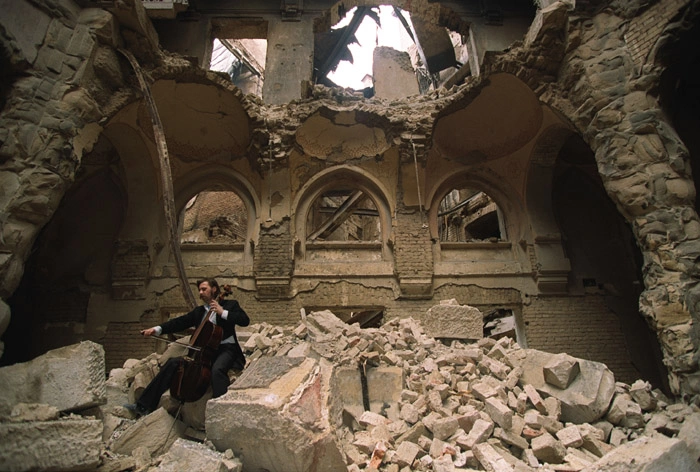
Conflicts and post-conflict reconciliation are deeply rooted in how the past is remembered and how collective memory is reconstructed.
These processes are shaped by power relations and are increasingly mediated—and potentially manipulated—by new mnemonic technology, specifically artificial intelligence (AI).
This raises urgent ethical questions, concerns about justice, and the risk of generating new forms of conflict.
AI and the past
Artificial intelligence (AI) is widely discussed for its impact on the future, yet its influence on the past—particularly on personal and collective memory—remains underexplored.
Building on the “reconstructive turn” in memory studies and the more recent “digital turn,” this lecture examines how AI and digital technologies disrupt traditional processes of forming, reconstructing, and preserving memory.
While AI offers opportunities to foster more inclusive and accessible forms of collective memory, it also introduces significant risks, including manipulation, distortion, and fabrication. The distortion of memory through AI technologies also opens the door to forms of cognitive warfare.
Manipulation, polarization and desinformation
By subtly altering, amplifying, or fabricating narratives about the past, AI can influence how individuals and societies perceive reality, identity, and historical truth.
Such manipulation can be deployed strategically to polarize communities, reinforce ideological divisions, or undermine trust in institutions and shared knowledge systems.
When collective memory becomes unstable or contested due to algorithmic intervention, it creates fertile ground for disinformation campaigns that operate not only on present facts but on the very foundations of remembered experience.
In this sense, AI-driven memory distortion is not merely an ethical or technological issue, but a geopolitical one, where control over memory becomes a tool of influence and power.
Virtual witnessing
These dynamics are illustrated through the example of “virtual witnessing” in the USC Shoah Foundation’s “New Dimensions in Testimony” project, which employs AI-driven holographic technologies to create interactive testimonies.
Such systems simulate dialogue and presence, enabling users to engage with representations of past experiences in ways that blur the boundaries between lived memory and its digital reconstruction.
More broadly, AI systems—including large language models—function as mechanisms for compressing the past by selecting, summarizing, and rearticulating historical knowledge. In doing so, they shape how memory is formed, accessed, and interpreted, while embedding editorial choices, potential biases, and the risk of privileging dominant or homogenized narratives.
About Jasna Ćurković Nimac
Jasna Ćurković Nimac is Full Professor at the Department of Communication Studies at the Catholic University of Croatia,
where she was appointed Vice-Rector for International Cooperation in 2024. She earned her PhD in Moral Theology in 2008 from the Accademia Alfonsiana in Rome. Her research focuses on the ethics and neuroethics of memory, the impact of new technologies and artificial intelligence on individual and collective memory, and the ethics of intercultural communication.

FUCE Summer School
We are organizing this public lecture as part of the FUCE Summer School.
The full programme is reserved for the selected candidates.
However, you can join us in person or online for this public lecture or the MYEurope panel debate, where summer school students will share their dreams and concerns about Europe.
European Humanism in the Making of Peace
The 7th edition of the FUCE Summer School invites students and scholars to reflect on how peace can once again become a creative, moral, and cultural project for Europe.
This summer school offers bachelor students the opportunity to engage with leading thinkers, critically analyse the roots and consequences of populism, and explore innovative approaches to strengthen democracy in the 21st century.