Watch the webinar!
FUCE Summer School on European Humanism
This week, the 7th FUCE Summer School opens at the Université Catholique de Lille. Under the title European Humanism in the Making of Peace, undergraduate students from across Europe and beyond will spend five days exploring how peace can once again become a creative, moral, and cultural project for the continent. UCSIA coordinates the programme.
FUCE Summer School lecturer Michael Shortall (St. Patrick’s Pontifical University, Maynooth) held a preparatory webinar with participating students.
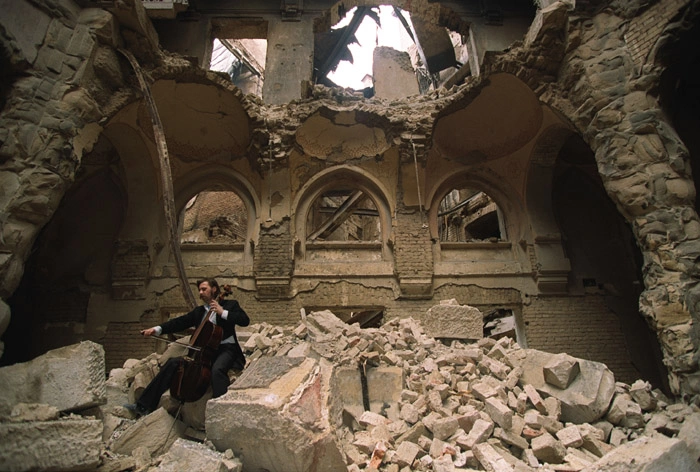
A cellist among the ruins
Shortall opened with a story from the siege of Sarajevo. On 27 May 1992, artillery shells struck a bakery in the besieged city, killing 22 people.
The following day, a cellist named Vedran Smailović dressed in his concert attire, took his seat among the ruins, and played Albinoni’s Adagio in G minor. He returned every day for 22 consecutive days — one for each victim — performing in the open air as sniper fire continued around him.
He wasn’t stopping tanks or negotiating treaties. But his music became a refusal to allow the logic of destruction to define reality completely.
That image set the theme for the entire webinar: peace is far more than the absence of war. Beneath every stable society lies a deeper question: how are we to be human together?
Shortall argued that the most pressing European crises today are not merely political or economic but anthropological. They reflect a weakening of the shared understanding of what human beings are and what binds them together. When that understanding becomes thin, public discourse grows tribal and citizens stop encountering each other as neighbours in a common project.
Living within the lie and the truth
To think through this diagnosis, Shortall turned to Václav Havel, the Czech playwright and dissident whose landmark essay The Power of the Powerless was written in 1978.
Havel observed that oppressive systems sustain themselves not through fear alone, but through the everyday conformity of ordinary people who learn to “live within the lie”.
His famous image is a green grocer who displays a political slogan he doesn’t believe in — not out of conviction, but because the system expects it. Over time, moral language hollows out and human beings divide internally between public performance and private conviction.
Shortall extended this diagnosis to our own era. Consumer culture and technology, Havel already noted, reinforce post-totalitarian conformity in their own way: numbing people, or reducing them to serving the algorithm rather than mastering it.
Yet The Power of the Powerless is ultimately a hopeful text. Havel’s answer is living within the truth: not dramatic rebellion, but small daily acts of honesty, responsibility, and refusal to participate in falsehood.
These quiet gestures are the seedbed of genuine freedom. And lasting political change, Havel insisted, cannot happen without this kind of prior moral and spiritual renewal.
Pope Leo XIV's Magnifica Humanitas
Alongside Havel, Shortall drew on Pope Leo XIV, whose first encyclical Magnifica Humanitas had been published just days before the webinar. Directed primarily at artificial intelligence, the document also addresses war and peace with particular urgency.
Leo XIV warns against a “culture of power”: a political or technological mentality willing to sacrifice human dignity in pursuit of advantage — and raises alarm about the normalization of war and the growing psychological acceptance of permanent militarization in contemporary Europe.
On the use of AI in armed conflict, his position is unequivocal: lethal or irreversible decisions must never be entrusted to artificial systems, and no algorithm can make war morally acceptable.
Against the culture of power, he proposes the “civilization of love” — the conviction that human beings remain capable of goodness, solidarity, and renewal, and must never be reduced to instruments of any kind.
To ward off any accusations of pessimism, the encyclical turns to an unlikely source: Gandalf the wizard in ‘The Lord of the Rings’. It is, Shortall noted, probably the first time a pope has ever quoted a wizard.
The dissident next door
Both Havel and Leo XIV share a fundamentally anthropological concern: what does it mean to be fully human when political, technological, or cultural systems seek to diminish that humanity? And both ultimately hold out hope.
At the close of the webinar, Shortall returned to the cellist of Sarajevo. Vedran Smailović was, in Havel’s terms, a dissident — not a revolutionary, but someone who refused dehumanization in his daily life and insisted that truth, and beauty, matter even when the logic of war says otherwise.
Lasting peace is not built at the negotiation table alone. It begins in the recognition of our shared humanity and in the small, daily acts of integrity through which we become people — and societies — capable of resisting violence.
The FUCE Summer School programme
The main programme is reserved for participating students, but two sessions are open to all, live in Lille or online.
In the public lecture From Memory to Conflict: Algorithmic Mediation of the Past on 30 June, Professor Jasna Ćurković Nimac (Catholic University of Croatia) will discuss how artificial intelligence is impacting the way we remember and reconstruct the past.
On 1 July, the students will take centre stage at MYEurope, where they will share their hopes and concerns for Europe’s future in a panel discussion moderated by Peter Hanenberg (Universidade Católica Portuguesa).