The lecture will be held in Dutch. Admission is free and everyone is very welcome, but please remember to register in advance.
UCSIA is organizing this event in collaboration with Pax Christi.
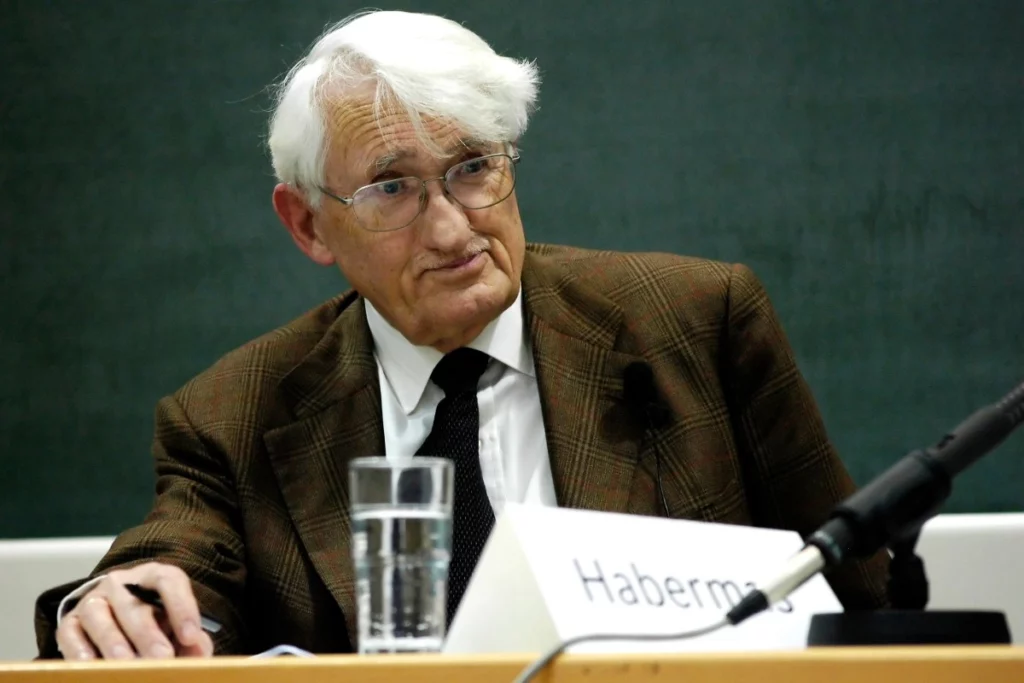
Jürgen Habermas (1929-2026)
Jürgen Habermas was one of the most influential philosophers of the twentieth century. As a leading thinker of the Frankfurt School, he developed the ‘Theory of Communicative Action’.
Throughout his work, Habermas consistently emphasized the importance of democracy, the rule of law and dialogue free from coercion. In recognition of his lifelong commitment to democracy, he was awarded the Erasmus Prize in 2013.
What holds a democratic society together when its citizens differ fundamentally from one another?
This question runs like a common thread through Habermas’s work and may be more urgent today than ever.
Habermas did not seek the answer in a shared heritage, religion, or way of life, but in the possibility of engaging in dialogue with one another as free and equal citizens.
Concepts such as communicative rationality, the public sphere and constitutional patriotism form the building blocks of this democratic ideal. Yet another concept, less frequently placed centre stage, also plays an important role: solidarity.
Habermas once described solidarity as the other side of justice. Justice protects the equal freedom of every individual; solidarity refers to the mutual commitment without which that freedom is difficult to conceive.
But is that enough? Can a just democracy itself generate the solidarity it needs? Can constitutional patriotism unite people who have little else in common? And what happens when citizens are no longer willing to listen to one another’s arguments?
In this session, we will not only reflect on Habermas’s legacy but, above all, engage in discussion with Habermas. Following a brief introduction to his thought, participants will discuss several key questions in small groups, based on a text they will have read in advance. We will conclude with a plenary reflection: is solidarity indeed the flip side of justice – or is it not?
Recommended literature
To prepare for the lecture, you can read the recommended reading here in advance.
A Plea For European Solidarity (26p) is Chapter 1 from the book The Lure of Technocracy (2015).
Citizenship and National Identity (25p) was published as an appendix in the book Between Facts and Norms: Contributions to a Discourse Theory of Law and Democracy (2016).
Jürgen Habermas, “Justice and Solidarity: On the Discussion Concerning ‘Stage 6′”, in Thomas E. Wren (ed.), The Moral Domain, MIT Press, 1990, pp. 224–251.
Programme
-
6:00 pm | Welcome
by Tom Sauer, Professor of International Politics at the University of Antwerp and Chair of the Security and Disarmament Working Group at Pax Christi Flanders -
6:10 pm | Lecture: ‘Solidarity as the Flip Side of Justice — or Is It?’
by Peter Thijssen, Professor of Political Sociology at the University of Antwerp - 6:40 pm | Group discussion
- 7:30 pm | Closing plenary reflections
- 8:00 pm | End
About Peter Thijssen
Peter Thijssen is Professor at the Faculty of Social Sciences at the University of Antwerp and a researcher with the M2P research group (Media, Civil Society and Politics).
His research in political sociology focuses on political participation, the personalization of voting behaviour, public opinion on high-tech issues such as nuclear energy, and solidarity in the political communication of parties and voters.
He combines his research with teaching in statistics, public opinion and political communication, and has recently published in journals such as Acta Politica and the Journal of Risk Research.